Stay Updated
Get instant alerts the moment your load plans are ready.
Email gets delayed, but our second layer provides immediate alerts that work even when the app is closed in your browser.
Get instant progress updates on your multiple devices.
No spam, and you can unsubscribe at any time.
Notifications are currently blocked. To enable instant load plan alerts:
1. App-Level Settings:
Check your LoadViewer account preferences or notification profile settings to ensure alerts are turned on internally.
2. Browser-Level Settings:
• Click the lock, settings, or sliders icon in your browser's address bar.
• Find Notifications and change it from Block to Allow or Reset.
• Refresh this page.
Container Load Planning
Container load planning determines how cartons and SKUs are distributed across shipping containers before freight is booked or warehouse loading begins. Exporters and logistics planners use load planning to estimate how many containers are required, evaluate how cartons should be arranged, and ensure container space is utilized efficiently while respecting real-world shipment constraints. By planning container loads in advance, exporters can avoid partially empty containers, identify whether additional cartons should be included, and make more informed freight booking decisions.
What is Container Load Planning?
Container load planning happens before a shipment is physically loaded into containers. Exporters evaluate carton dimensions, quantities, and container capacity in order to determine how goods should be distributed across one or more containers.
Instead of loading cartons randomly at the warehouse, planners first simulate the container arrangement to understand how efficiently the shipment can utilize container space. Proper load planning helps exporters avoid partially empty containers, reduce shipping cost per CBM, and improve shipment predictability before freight booking.
When Container Load Planning Happens in Export Shipments
In real export operations, container load planning typically happens after production quantities become available but before containers are booked with the shipping line.
At this stage, exporters may already know the SKU quantities ready for shipment but must determine how these cartons will be distributed across containers. Planning at this stage allows exporters to decide whether additional cartons should be included, whether shipments should be consolidated, or whether container bookings should be adjusted.
Key Inputs Required for Container Load Planning
Accurate container load planning depends on reliable shipment data. Planners typically evaluate several operational inputs before determining how goods should be arranged inside containers.
- Carton dimensions (length, width, height)
- Carton weight
- SKU quantities ready for shipment
- Container internal dimensions (20GP, 40GP, 40HC)
- Stacking limitations or fragile cargo restrictions
- Warehouse loading constraints
Typical Problems in Container Load Planning
Although container load planning appears straightforward, real export shipments involve several operational challenges that can significantly affect container utilization.
Uneven SKU Quantities
Export shipments often contain multiple SKUs with different carton sizes and quantities. Some SKUs may occupy a large portion of the container while others fill only small gaps. This imbalance can make it difficult to achieve efficient packing without careful planning.
The Last Container Problem
In multi-container shipments, exporters often focus on filling the first few containers efficiently. However, the final container frequently becomes inefficient because the remaining SKU quantities do not perfectly match container capacity.
Load planning tools help visualize this imbalance early and allow planners to evaluate how cartons can be redistributed across containers before freight is booked. In many shipments, the weakest container determines the economics of the entire shipment.
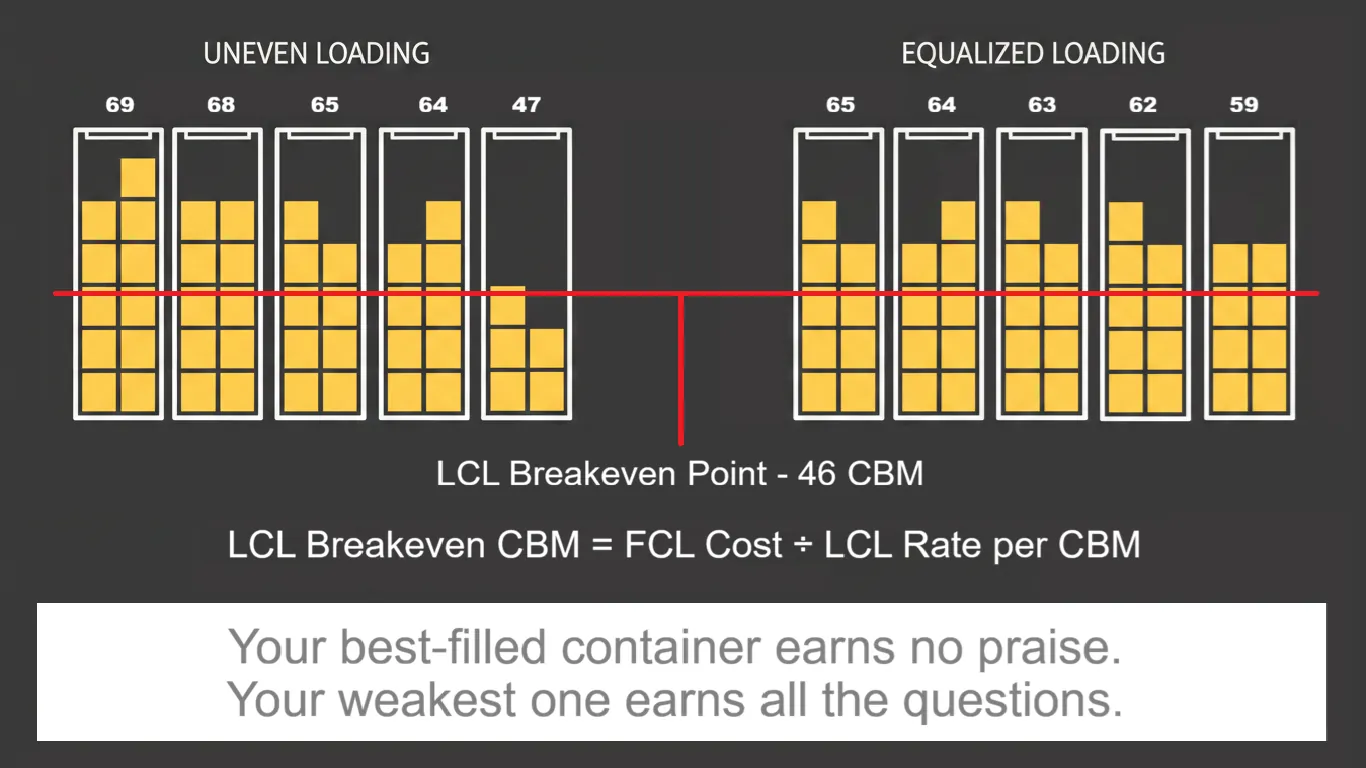
Uneven container distribution often results in a weak final container. Balanced planning distributes cartons more evenly across containers and helps exporters evaluate the LCL breakeven point before booking freight.
In export shipments, container efficiency is not only a logistics metric. Well-balanced containers allow shipments to move predictably and buyers often receive consistent carton quantities across containers. Uneven loading, however, can create inefficient final containers, unexpected partial shipments, or higher freight costs. In practice, exporters often balance carton quantities across containers instead of filling them sequentially. This equalization improves overall container utilization and reduces the risk of shipping a partially empty final container.
Shipment Readiness Differences
In many export operations, different products become ready for shipment at different times. Exporters must decide whether to ship partially ready quantities or wait for additional cartons in order to achieve better container utilization.
How Exporters Traditionally Plan Container Loads
Many exporters still plan container loads manually using spreadsheets or rough CBM calculations. While this approach can estimate the total shipment volume, it does not accurately simulate how cartons will actually fit inside the container.
As shipments become more complex with multiple SKUs and varying carton sizes, manual planning becomes increasingly difficult and may lead to inefficient container utilization.
How Container Load Planning Software Helps
Modern container load planning software uses 3D bin packing algorithms to simulate how cartons can be arranged inside shipping containers before the shipment is loaded.
These tools allow planners to visualize carton placement, test different shipment combinations, and validate container feasibility before booking freight. By identifying efficient packing arrangements early, exporters can reduce unused container space and improve overall shipment efficiency.
Planning Containers Before Freight Booking
Experienced exporters rarely wait until warehouse loading to understand container utilization. Instead, they simulate container loading earlier during shipment planning. This allows them to identify whether cartons should be redistributed across containers, whether additional quantities should be included, or whether shipment consolidation is required.
Planning containers before booking freight helps reduce shipping cost per unit, avoid last-minute loading surprises, and ensure that warehouse operations follow a clear loading plan.
Common Questions About Container Load Planning
Exporters often search for practical guidance when planning container shipments. Container load planning helps determine how cartons should be distributed across containers, how many containers are required for a shipment, and how to avoid partially empty containers.
Many logistics planners evaluate container load feasibility before booking freight by simulating carton placement, calculating total shipment volume, and identifying whether additional cartons should be added to improve container utilization.
Container Load Planning Questions
-
How does LoadViewer help in shipment planning?
LoadViewer assists in shipment planning by automatically generating optimized load arrangements, checking feasibility, and allowing for easy 3D visualization.
-
Why Do Container Loading Plans Fail and How to Fix Them?
Learn why container loading plans fail in real shipments and how to fix common issues like wrong inputs, unused space, and execution gaps.