Stay Updated
Get instant alerts the moment your load plans are ready.
Email gets delayed, but our second layer provides immediate alerts that work even when the app is closed in your browser.
Get instant progress updates on your multiple devices.
No spam, and you can unsubscribe at any time.
Notifications are currently blocked. To enable instant load plan alerts:
1. App-Level Settings:
Check your LoadViewer account preferences or notification profile settings to ensure alerts are turned on internally.
2. Browser-Level Settings:
• Click the lock, settings, or sliders icon in your browser's address bar.
• Find Notifications and change it from Block to Allow or Reset.
• Refresh this page.
Container Loading Software
Container loading software helps exporters and logistics planners determine how cartons and SKUs should be arranged inside shipping containers before freight booking or warehouse loading begins. By simulating carton placement digitally, planners can evaluate container feasibility, improve container space utilization, and reduce the risk of partially empty containers.
Modern container loading software analyzes carton dimensions, shipment quantities, and container specifications to generate optimized load plans for real export shipments. This allows planners to validate shipment feasibility early, identify inefficient container distribution, and ensure that warehouse teams receive clear loading instructions before containers arrive for loading.
What is Container Loading Software?
Container loading software is a digital tool used to simulate how cartons can be arranged inside shipping containers. Instead of relying on rough CBM calculations or manual estimation, planners can visualize how cartons will actually fit inside the container before the shipment is physically loaded.
These tools analyze carton dimensions, quantities, and container specifications to generate optimized loading arrangements. By simulating container loads in advance, exporters can verify whether shipments will fit into available containers and identify opportunities to improve container utilization. In many shipments, the weakest container determines the economics of the entire shipment.
Why Exporters Use Container Loading Software
Modern export shipments often contain multiple SKUs with varying carton sizes and quantities. Planning such shipments manually can be difficult and may result in inefficient container usage. Container loading software allows planners to evaluate different loading scenarios and identify arrangements that maximize container space utilization.
By testing different carton combinations before freight booking, exporters can reduce the risk of shipping partially empty containers and make better decisions about shipment consolidation or container allocation.
Problems With Manual Container Planning
Many exporters still estimate container requirements using spreadsheets or total CBM calculations. While these methods can provide rough volume estimates, they cannot accurately predict how cartons will physically fit inside the container.
As shipments become more complex with mixed carton sizes and multiple SKUs, manual planning often leads to inefficient packing arrangements and underutilized containers. The final container in a shipment frequently becomes partially empty because remaining cartons cannot be arranged efficiently.
How Container Loading Software Works
Container loading software analyzes shipment data such as carton dimensions, quantities, and container specifications to determine how goods can be arranged efficiently inside shipping containers.
Shipment data may come from enterprise systems such as ERP platforms or can be entered manually by planners. The software then evaluates different packing arrangements using optimization algorithms and generates feasible container load plans.
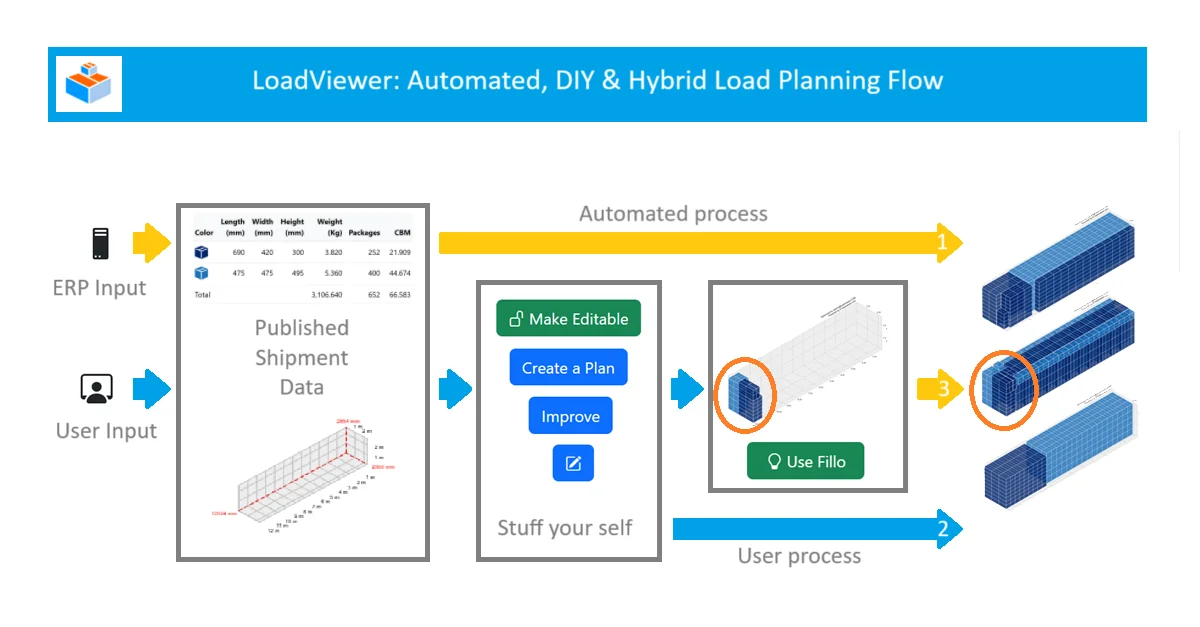
The diagram illustrates how shipment data flows through container loading software. LoadViewer supports automated optimization as well as planner-guided improvements. More details about the platform workflow are available on the LoadViewer introduction page.
Planners can review the generated load plans, adjust carton placement when necessary, and validate whether the shipment fits efficiently within the selected container type.
Benefits of Using Container Loading Software
Container loading software helps exporters plan shipments more accurately by simulating how cartons will actually fit inside shipping containers. Instead of relying only on rough CBM calculations, planners can validate container feasibility before freight booking and understand how efficiently their shipment will utilize container space.
- Improves container space utilization
- Reduces partially empty containers
- Helps evaluate shipment feasibility before freight booking
- Supports planning for multi-SKU shipments with different carton sizes
- Provides clear loading instructions for warehouse teams
How Container Loading Software Improves Daily Operations
In real export operations, shipments rarely consist of identical cartons. Most shipments include multiple SKUs with different carton sizes, quantities, and stacking constraints. Container loading software helps planners evaluate these complex combinations before the shipment reaches the warehouse.
In many cases, cartons must also respect purchase-order quantities or minimum shipment commitments agreed with buyers. Software-assisted load planning helps planners balance these commercial constraints while still achieving efficient container utilization.
Validated load plans also improve coordination between planning and warehouse operations. Instead of relying on rough estimates, warehouse teams receive clear loading instructions that reduce confusion, prevent last-minute adjustments, and help shipments move more predictably through the loading process.
Taken together, these improvements help exporters move from reactive container loading toward structured shipment planning supported by validated container load plans.
How Exporters Evaluate Container Loading Software
When selecting container loading software, exporters typically evaluate whether the tool can accurately simulate real shipment conditions. A reliable container loading system must consider carton dimensions, stacking constraints, container specifications, and SKU quantities in order to generate feasible load plans.
Beyond basic carton placement, planners often expect container loading software to provide clear visualization of the loading arrangement so that warehouse teams can follow the loading sequence correctly. Visual load plans help reduce loading errors and ensure cartons are placed inside the container as intended.
Exporters also evaluate whether the software can handle mixed SKU shipments efficiently. In real export operations, shipments rarely consist of identical cartons. Container loading software must therefore generate practical arrangements for cartons of different sizes while maximizing container space utilization.
Tools that allow planners to simulate container loads before freight booking help exporters make better shipment decisions and reduce the risk of shipping partially empty containers.
Container Loading Software in Shipment Planning
In practice, container loading software is often used during the shipment planning stage, after carton quantities become available but before containers are booked with the shipping line.
By simulating container loads early, exporters can identify both risks and opportunities in the shipment plan. Planners can evaluate whether cartons should be redistributed across containers, whether additional quantities should be included, or whether shipment consolidation can improve overall container utilization.
Detecting these factors early allows exporters to make better freight booking decisions, improve shipment economics, and achieve better container utilization without increasing logistics costs.
Industrial-scale container loading software often integrates with enterprise systems such as ERP, WMS, and TMS platforms. These integrations allow planners to import shipment data automatically, eliminate manual data entry errors, and process large shipment datasets efficiently during container load planning.
Container Loading Software Questions
-
What is LoadViewer?
LoadViewer is a cloud-based software that provides an intuitive 3D planning engine to help you optimize cargo space and create accurate load plans efficiently.
-
What industries can benefit from using LoadViewer?
LoadViewer improves efficiency and savings for exporters, manufacturers, 3PLs, and freight forwarders, where space and approvals are critical.
-
Is LoadViewer suitable for international shipments?
Manage international shipments efficiently with LoadViewer's support for multi-destination planning and global logistics workflows.
-
Is LoadViewer suitable for both small and large-scale logistics operations?
LoadViewer is a flexible and scalable solution for logistics operations of all sizes, from small exporters to large, multi-container fleets.
-
Can I import my existing product data into LoadViewer?
Import existing product data into LoadViewer easily via CSV/Excel or direct integration, ensuring accuracy and saving time on data entry.
-
Can I generate reports or packing lists from a completed load plan?
Create and export detailed reports and packing lists from your load plans, providing clear instructions for warehouse teams.
-
Is LoadViewer available as a cloud-based solution?
Access LoadViewer from anywhere via the cloud, with automatic updates and no infrastructure hassles for your logistics team.
-
Do I need to signup to try a demonstration?
Experience LoadViewer's powerful calculations with a free demonstration. Business users get five free demos without needing to sign up.
Try Container Load Planning with Real Shipment Data
While container loading software explains the principles of efficient shipment planning, the real value appears when planners test their own shipment data. By entering carton dimensions, quantities, and container specifications, exporters can immediately see how cartons will be arranged inside the container and whether the shipment fits as expected.
Testing a shipment digitally allows planners to evaluate container utilization, identify inefficient loading patterns, and explore opportunities to improve shipment economics before freight is booked.
This approach helps exporters move from theoretical planning to practical shipment validation while reducing the risk of partially filled containers.